Master Daddy: A Bold Script Font for Confident Digital Design
In the visual economy of the web, your typography is often the first and most resonant brand ambassador. As a designer structuring digital experiences, I'm constantly evaluating fonts not just for their aesthetic appeal, but for their functional performance in layouts, their ability to guide users, and their power to cement a brand's tone. A font like Master Daddy enters this space with a distinct proposition: a bold, fluid script designed to exude strength and charisma. It's more than a decorative element; it's a strategic design asset.
The Digital Personality of Master Daddy
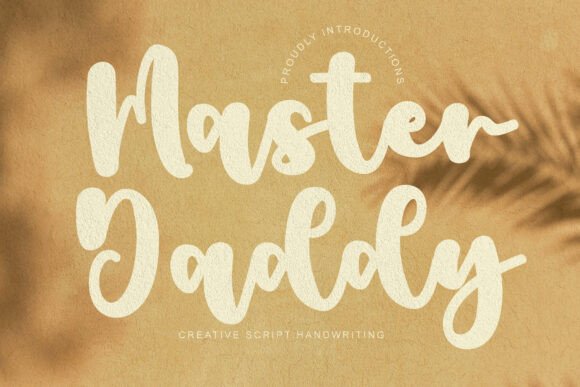
Master Daddy is immediately recognizable as a dynamic script typeface. Its strokes are confident and fluid, avoiding the overly delicate or whimsical feel of some handwritten fonts. This gives it a grounded, premium quality. The bold weight ensures it holds its own on any screen, from dense desktop hero sections to the constrained real estate of a mobile banner. The elegance in its curves suggests a modern, creative professionalism—ideal for brands that want to appear both authoritative and approachable. This isn't a font that whispers; it makes a statement.
In practical terms, this personality translates directly to user perception. A boutique online store using Master Daddy for its hero title immediately communicates curated quality and confidence. A coach or consultant using it for their name on a landing page establishes immediate presence and expertise. The charisma baked into the letterforms helps build brand trust before a user reads a single line of body copy.
Strategic Applications in Web Layouts
The true test of any display font is how it performs in the wilds of live websites and apps. Master Daddy, with its bold script style, excels in specific, high-impact roles that define visual hierarchy.
Defining Visual Hierarchy with Hero Titles and Headings
This is Master Daddy's primary strength. Its bold nature commands attention, making it perfect for the main headline on a landing page, portfolio site, or product launch screen. It creates an instant focal point. When a user scans a page, their eye is naturally drawn to the most distinctive typographic element. By assigning Master Daddy to your H1 or key H2s, you control that scanning behavior, guiding users to your most important message—be it a value proposition, a course title, or a flagship product name.
Elevating Calls-to-Action and Interactive Elements
While typically used sparingly on UI elements, a bold script can be incredibly effective for primary call-to-action buttons on certain brand-focused sites. Imagine a "Book Your Session" or "Launch the Experience" button set in Master Daddy on a site for a high-end creative agency. It personalizes the action, making it feel like a direct, confident invitation rather than a generic prompt. For conversion-focused layouts, this subtle psychological nudge can be powerful.
Creating Decorative Accents and Brand Anchors
Beyond large headlines, Master Daddy serves as a brilliant decorative accent. Use it for pull-quotes in blog articles, stylized numbers in statistics sections, or short branded phrases in website footers. It can form the basis of a text-based logo or wordmark for digital products, online stores, and SaaS brands, ensuring consistent online identity across every touchpoint from the website header to social media graphics.
Readability and Responsive Considerations
Any discussion of script fonts in web design must address readability. Master Daddy's bold strokes are a significant advantage here, as they prevent the letters from becoming thin and breaking up on screens. However, best practices are non-negotiable.
Always use Master Daddy for display purposes only—headings, short phrases, logos. Never for body copy or lengthy paragraphs. On mobile screens, ensure font sizes are generous. A title that looks commanding at 80px on desktop might need to be adjusted to 50px on mobile to maintain legibility and proper letter spacing without crowding.
Contrast is critical. On light backgrounds, ensure the font color is dark enough. On dark backgrounds or image overlays, a pure white or very light tint often works best. Always test your live designs on multiple devices. Pay special attention to small buttons; if using Master Daddy there, increase padding significantly to let the letterforms breathe.
Practical Font Pairing for the Web
A bold script font like Master Daddy needs a strong supporting cast. The most effective and common strategy is to pair it with a neutral, highly readable sans-serif for all body text, UI labels, and secondary information. Fonts like Inter, Open Sans, or system-ui fonts provide a clean, modern base that allows Master Daddy to shine without competing.
For a more editorial or classic digital identity, a refined serif font for subheadings and pull-quotes can add sophistication. Think of Playfair Display or Source Serif Pro. The key is contrast: the simplicity of the supporting typeface highlights the expressive complexity of the script. This pairing creates a clear, professional typographic system that enhances scanning, readability, and overall layout rhythm.
Technical and Licensing Essentials for Digital Work
Before integrating Master Daddy into any client project or commercial website, a professional check is mandatory. Verify the license covers your intended use—web embedding for websites, desktop use for creating graphics, and inclusion in digital templates for sale. Most premium font licenses for web design will provide webfont files (WOFF2, WOFF) or offer a code for services like Google Fonts or Adobe Fonts.
Check for included styles and features. Does Master Daddy offer alternates or swashes that can be accessed via OpenType features in design software for unique logos? Is it a single weight, or are there lighter or heavier variants for hierarchy? Multilingual support is also crucial for global brands. Finally, ensure the technical implementation is clean: use proper @font-face rules in your CSS, and always have fallback fonts (like cursive) defined for performance and fail-safety.
Master Daddy represents a specific tool in the web designer's kit: a font of personality and power. By deploying it strategically—for hero titles that capture attention, for branded phrases that build identity, and for accents that create memorability—you leverage typography not just as decoration, but as a fundamental component of usability, brand tone, and digital engagement. It enables the creation of web experiences that feel deliberate, confident, and uniquely compelling.